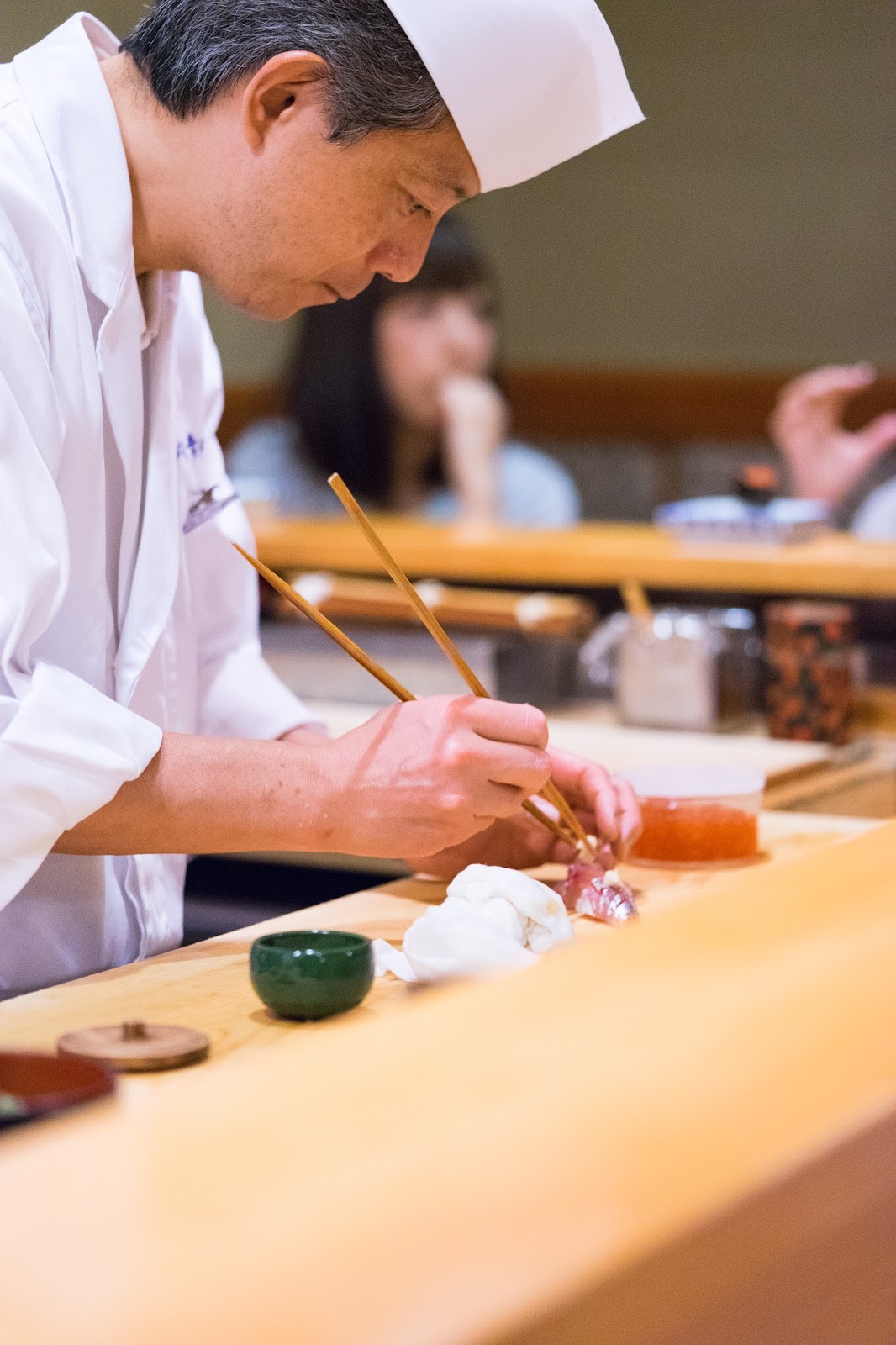
Tokyo is the capital of Japan and in many people’s opinion, the sushi capital of the world. The city has Tsukiji Fish Markets providing some of the highest quality seafood in the world and amazing sushiya (sushi restaurants) operated by masters who have dedicated decades to their craft.
These sushiya inc
lude Sukiyabashi Jiro (made famous around the world in the movie “Jiro Dreams of Sushi”) or other three Michelin star places such as Sushi Saito and Sushi Yoshitake (not to mention the myriad of one or two Michelin star sushiya in Tokyo). From what I can gather, it appears impossible to say that any particular sushiya is the “best”. Each high end sushiya take fish and rice and create magic in their own style.
Getting a booking at a top level sushiya is extremely difficult, particularly if you don’t book a few months in advance. I tried making reservations with those sushiya about 3 weeks before my trip with no luck. Luckily, I stumbled across an article written by Wakuda Tetsuya for Australian Gourmet Traveller where he said his favourite sushiya in Tokyo was Sushiko Honten.
Given Tetsuya’s reputation in the Australian restaurant circle, I was intrigued and a quick international phone call later, I had my booking!
I want to caveat this post by saying that I am not an experienced sushi connoisseur. I haven’t been to the constellations of the sushi world and I can’t give you a detailed analysis of the qualities of the neta (fish) and shari (rice). However, I can say that lunch at Sushiko Honten was the best meal I had in Tokyo and the best meal I've had in my life. In that way, it is an excellent introduction to high level sushiya and develop a sushi addiction.
Sushiko Honten Ginza
Lets first talk about Ginza. Ginza epitomises Tokyo to me. It is clean, futuristic and filled with luxury for those who can afford it. The top luxury brands in the world line the sides of Chuo-dono (the main street in Ginza) and its only natural that the quality of food in Ginza reaches similar heights. In particular, there are several high end sushi restaurants that call Ginza home such as Sukiyabashi Jiro, Sawada Sushi Yoshitake, Sushi Kanesaka and the subject of today’s post, Sushiko Honten.
Sushiko Honten was established in 1885 and at 130 years old, it is one of the oldest sushi restaurants in Tokyo and has one Michelin star. The restaurant is hidden away in one of the side streets off Chuo-dono, with no English signage or anything advertising the quality sushi within.
Step inside and you go from the bright lights and hustle and bustle of Ginza to a dimly lit, peaceful oasis. It was almost like stepping into a theatre with the play being put on by the sushi chefs. Most of the space in the restaurant is taken up by a 10 seat bar behind which the sushi chefs work.
There were only seven of us in the restaurant for lunch so each group got their own private sushi chef. The chef that attended to us was Akira Mizutani (no relation to Sushi Mizutani, another sushiya) who had been working there for over 13 years. Although he was not the head chef of Sushiko Honten, I had absolutely no complaints; everything he served was perfect.
 |
| Head chef Mamoru Sugiyama |
Sushi
Similar to other high end sushiya, Sushiko Honten is primarily omakase (chef's selection) though you can also order extra pieces to supplement the selection. As I said in my previous post on Sushi Dai, omakase is the way to go! You get to taste the freshest and best seafood from Tsukiji that morning and experience things out of your comfort zone.
Bearing in mind that this is my first high end sushi experience and I haven't been to other high end sushiya such as Sukiyabashi Jiro, Sawada or Sushi Saito, my overall experience at Sushiko Honten was amazing. I've summarised my thoughts on the restaurant in a few points below:
- The seafood was impeccably fresh and well prepared. It was also well proportioned to the amount of rice in each piece.
- The rice was the perfect temperature and stuck together well (no issues with bits of rice coming off as I picked it up). I've heard that Jiro's style of sushi rice is quite vinegar-y, but I didn't feel there was too much or too little vinegar in the rice here.
- The otsumami (appetisers before the nigiri/sushi) such as the abalone were superb!
- The preparation of each piece was theatre in itself. Watching the chef grill pieces of fish over charcoal or slice and garnish seafood or even the deceptively simple act of compacting sushi were all done with expert precision and grace.
- Our chef (Akira Mizutani) spoke reasonably good English and very friendly! He chatted to us throughout the whole lunch (though not in a way that was intrusive) and was happy to answer any question we had about what he was doing/the sushi being served.
- The atmosphere in the restaurant was very peaceful and time just flew by. The whole lunch took about 1.5 to 2 hours and we did not feel rushed at all (which is a complaint some have levelled against other sushiya). I think the chef slowed down the rate of the meal when he saw me take time to photograph each piece.
On that note, its sushi photo time!
 |
| Two kinds of shrimp |
The first dish was an appetiser of two kinds of shrimp, marinated and served with wasabi and finely sliced carrot. Light, fresh and balanced. A great way to start the meal!
 |
| Grating fresh wasabi root |
 |
Two kinds of abalone
Abalone from Chiba marinated in sake for 8 hours (left)
Abalone from Hokkaido marinated in soy for 2 hours(right) |
The second dish was two kinds of abalone. The first piece of Abalone was from Chiba prefecture and was marinated in sake from 8 hours (though I couldn't taste any alcohol, it must have evaporated when it was cooked). The second piece was from Hokkaido and marinated in soy for 2 hours.
Most abalone I've tried has been rather hard and rubbery. These two pieces were impeccably soft and slightly chewy, with a bit of bite too. Amazing texture and flavours; one of my favourite dishes from this lunch.
 |
| Aburi (grilled) tuna cheek |
 |
| Chu-toro (medium fatty tuna) |
The next dish was some aburi tuna cheek served with horse radish and chu-toro sashimi. Great way to experience different cuts of tuna.
I'm particularly partial to chu-toro as I think its has just the right amount of fat (akami is a bit boring but at times, the fatty o-toro can be a bit too rich if you have more than a few pieces).
 |
| Portioning tamagoyaki |
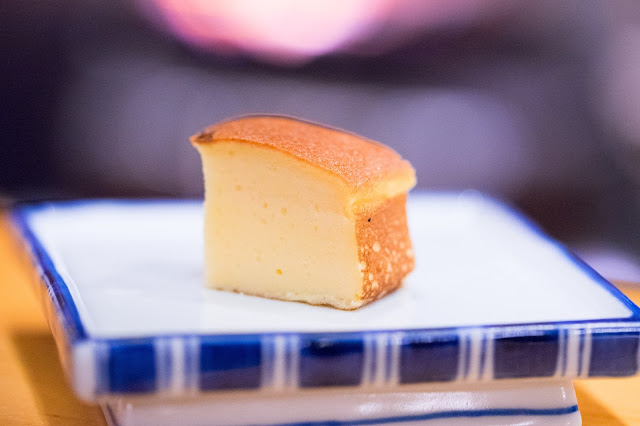 |
| Tamagoyaki (egg omelette) made with shrimp |
The next dish was a piece of tamagoyaki. This is an egg omelette made with shrimp that had a the consistency of soufflé or sponge cake.
One of the scenes in "Jiro Dreams of Sushi" was of Jiro's apprentice describing his journey learning how to make egg sushi. He had to make it more than 200 times before Jiro finally acknowledged that it was good enough. When I first watched that scene, I wondered... how can egg sushi be so hard to make and how can it be that good compared to the finest seafood available in Japan?
I wonder no more. Good tamagoyaki is traditionally seen as a test of a sushi chef's skills and this was probably the most amazing dish I had at Sushiko Honten (beating out abalone and the o-toro). It was fresh from the oven/stove. The texture was light and fluffy yet it had an incredible shrimp flavour that gave it both sweetness and umami. This was the perfect combination of taste, texture and temperature.
 |
| Aburi scallop |
Grilled scallop on a freshly toasted piece of nori (seaweed). Simple and delicious. I didn't have much time to take photos because the chef told us to eat it straight away to prevent the nori from becoming soggy.
 |
| Akagai (Arc Shell) |
 |
| Akagai connective tissue |
I don't eat much akagai in Sydney and I've never had akagai connective tissue before (which had a different, more crunchy texture to the Akagai body).
The akagai was actually alive when the chef served it to us and still moving! I must admit, it was very weird eating something that was still alive and moving. That said, its part of the experience and it was very tasty.
 |
| Tuna |
 |
| O-toro (fatty tuna) |
Click on the photo of the o-toro above to get a better look at that marbling. This was like eating kobe beef, but in fish form. It had the right amount of soy sauce brushed on it, the rice was the right temperature. Everything came together brilliantly as I bit into it and the tuna melted away in my mouth as I chewed. Looking at the photo now, I could really use another piece...
 |
| Prawn cooked for 20 seconds |
Our chef boiled the prawn in front of us for about 20 seconds, before peeling it and making the sushi. Biting into the prawn, it was fresh, sweet and perfectly cooked, with the inside still almost raw.
 |
| Preparing uni 1 |
 |
| Preparing uni 2 |
 |
| Murasaki uni (sea urchin) |
 |
| Bafun uni |
As part of the omakase, we were served two types of uni: Murasaki uni and Bafun uni, both from Hokkaido. I can't quite remember the differences between the two types of uni, though I do remember tasting a difference. However, both uni sushi were incredibly fresh, silky smooth and firm (instead of runny in consistency) and tasted of the sea. They were so much better than the uni you can get in Australia.
 |
| Grilled shiitake mushroom |
"Shiitake mushroom sushi?!? What?!" Those were my thoughts when our chef served us this piece but it definitely exceeded expectations. The grilled mushroom had great earthy smell and flavour and it was seasoned with a bit of salt and lime/yuzu (can't remember which) which went together perfectly.
 |
| Anago (sea eel) |
I'm not the biggest fan of eel, but I loved the caramelisation on the eel and it gave it a great balance between umami, salt and sweetness.
 |
| Aji (Horse Mackerel) |
The horse mackerel was incredibly fresh. That said, I was getting very full by this point and probably couldn't appreciate it as much as I wanted to.
 |
| Baby squid |
The chef used a single piece of baby squid for this sushi. The squid was soft and delicate, not at all tough or rubbery like some other squid I've tried. The chef asked if I would like more sushi, but after this piece, I was very full and had to decline.
Conclusion
While not the cheapest meal I had in Tokyo, lunch at Sushiko Honten was the clear winner. I could never have imagined that sushi (basically just rice and seafood) could be this good and after the meal, I was truly mind blown. I would choose another meal at Sushiko Honten over any restaurant (hatted or otherwise) in Australia.
Compared to sushi I've tried in Australia or even to the famous Sushi Dai at Tsukiji Fish Markets, the quality of sushi at Sushiko Honten feels like its on a whole new level.
Sushiko Honten introduced me to the world of high end sushiya and now I can't wait to go back to Japan and try more places! Maybe I'll even be able to get a booking this time.